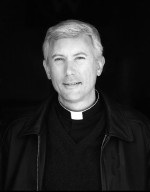
Today is the Feast of St. John Paul II, whose midnight Mass at St. Peter’s I served in 1986 as a seminarian in Rome. He shook my hand before Mass and, upon learning that I was an American, said “Yes! We must pray much for America!”
On this day in the year 1978, Karol Wojtyla appeared on the balcony above St. Peter’s Square as white smoke wafted above the Sistine Chapel. Non abbiate paura! the new pope cried out. Aprite, anzi, spalancate le porte a Cristo! “Do not be afraid!” he said. “Open, even fling wide, the doors [of your hearts] to Christ!”
Last Thursday six of us priests watched a movie on our day off, the 2019 film Ad Astra. It is one of those rare movies whose engaging plot does not depend on sex or violence. Even including a few sincere references to God, it’s about a young man facing his fear of the lonely reaches beyond Neptune, where his father is waiting for him. I remember sleeping under the stars in the High Sierra one night, looking into the billions of stars straight above me. I felt as if I were falling into infinite space, and it frightened me so badly that I had to move into a tent to get some sleep. The movie Ad Astra struck me deeply on the first watching, such that I watched it again the other night, paying close attention to all its finely-honed detail.
Seven years ago, Ad Astra foresaw the resurgence in religion among young men we are seeing in parishes today. The numbers seeking to become Catholic at Star of the Sea has tripled from 12 to 36 over the last three years. Most of those attending my 90-minute class on Wednesdays, and the overflowing evening Mass on Sundays, are young male tech professionals.
In Ad Astra, Brad Pitt plays Major Roy McBride, a young astronaut who has achieved top technological proficiency but who is searching for his long-lost father, for whose paternal love Roy has been searching all his life. Like his highly-decorated father, Major Roy McBride has trained his entire life’s focus on the space program, sacrificing everything, including wife and children, to his career.
Roy finds his father, sole survivor on the space station whose power surges are causing widespread devastation on earth. Roy has come to destroy the space station and rescue his father, but hears him say simply “I never cared about you or your mother….” Roy simply says “I know, Dad, but I still love you.” His father’s obsession with intelligent life on other planets has destroyed his family, but he has found nothing but cold dirt and dark rock across the solar system. “It means,” his son says, “that we are alone here with God.” His father refuses to accept this, and, in the end, unhooks his son’s lifeline and drifts into the blackness of space, a final isolation from any human contact. The son cries out in anguish at losing his father in the end, but he somehow finds the strength to return to earth, and to his estranged wife. His last words in the movie are “I will live, and love.”
The young men flooding my church have decided that they, too, will live, and love. Life without God, they have found, is just cold dirt and dark rock. They see their parents, siblings, and friends detaching from human contact, drifting off into the blackness of isolation. They want to return to God’s good earth from the bloodless sterility of today’s much-touted technocracy. They want to fling wide the portals of their hearts on the chance that there is life among the stars. They are on a mission to find the ultimate intelligent life of our universe, with the hope that this life has a name, Jesus Christ.

John Paul greeting his altar servers before Christmas Midnight Mass at St. Peter's, 1986

 RSS Feed